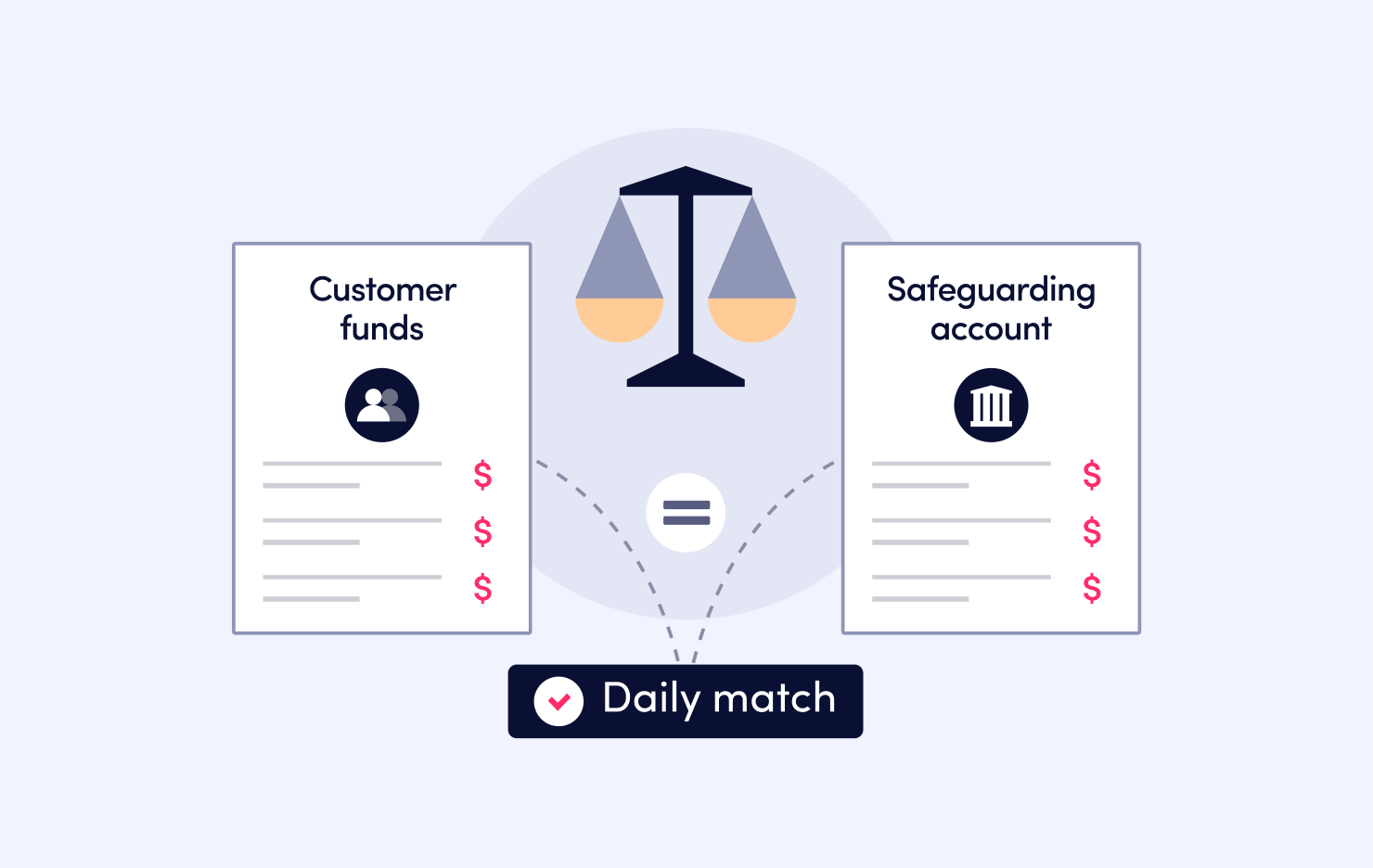
This article focuses on firms using the segregation method. Safeguarding reconciliation under CASS 15 is a daily cycle: each reconciliation day you run an internal reconciliation, covering the overall safeguarding position and D+1 placement where applicable, and an external reconciliation against third-party evidence, remediate internal shortfalls by the end of the day and investigate external discrepancies without undue delay, and keep a dated record of both. It runs every business day, not at month-end.
As of August 2026, under the FCA's PS25/12 and CASS 15.
01 - What is a safeguarding reconciliation, and why daily?
For firms using the segregation method, a safeguarding reconciliation checks whether the firm’s records show the correct safeguarding position and whether external evidence supports it. Under CASS 15 you do it at least once each reconciliation day, internally and externally. The daily cadence matters because a shortfall that sits undetected for weeks is exactly the failure the regime exists to prevent.
The FCA made the cadence explicit in PS25/12: an internal and an external safeguarding reconciliation must be performed at least once each reconciliation day, which means every business day, excluding weekends, bank holidays, and days the relevant foreign markets are closed. This is not a tightening anyone can phase in slowly — the Supplementary Regime has been in force since 7 May 2026.
The reason for the rigor is in the numbers. In 2024, EMIs safeguarded approximately £26 billion of relevant funds, while PIs safeguarded an estimated £6 billion on any given day. Among payment and e-money firms that became insolvent between Q1 2018 and Q2 2023, the average shortfall was 65%. Daily reconciliation is the control that catches a drift of a few thousand pounds before it becomes a structural hole.
Reconciliation starts before the calculation. The firm must first know which funds are relevant, where they sit and whether D+1 placement applies. If the classification is wrong, the reconciliation can balance and still confirm the wrong position.
02 - Step one: run the internal reconciliation
The internal reconciliation contains two checks under the standard method. The first compares safeguarding resource against safeguarding requirement. The second, where applicable, compares D+1 segregation resource against D+1 segregation requirement. The first asks whether the firm’s records show enough safeguarded value overall. The second asks whether the amount due in the formal safeguarding location has reached it.
In practice, the firm performs both checks using its internal records at a consistent reconciliation point, not bank statements. Where all relevant funds are already held in a relevant funds bank account, or were invested in relevant assets before the last reconciliation, the separate D+1 comparison may not apply.
If safeguarding resource and safeguarding requirement agree, the overall internal position balances. Where the D+1 check applies, that comparison must also be completed. Any internal break must be investigated and remediated within the applicable timeframe. It cannot wait for a weekly cycle.
03 - Step two: run the external reconciliation
The external reconciliation compares your internal records with records from the third parties holding relevant funds or relevant assets, including banks, account providers and custodians. It answers: does the outside world agree with our books?
This is where timing differences, missed postings, fees, and genuine errors surface. A payment that your ledger recorded but the bank has not yet settled, or a charge the bank applied that your records missed, both show up here. The external reconciliation is what turns "our books are internally consistent" into "our books match reality." The comparison should be performed account by account and currency by currency, while relevant assets should be compared investment by investment.
Both reconciliations are required each reconciliation day, and both feed the same evidence trail. The discipline that separates firms that pass supervision from firms that do not is treating the external reconciliation as non-negotiable daily work — not something done when someone has time.
04 - Step three: keep the record and respect the reconciliation day
Every reconciliation produces a dated record, and the records have to be continuous across the period because the annual audit and the FCA can sample any single day. The reconciliation is the control; the dated record is the proof, and the proof is what gets tested.
Each day’s record should show the requirement, the resource, the comparison result, any difference and how it was resolved. It should be captured as the reconciliation is performed, not reconstructed later. Because the obligation is to reconcile at least once each reconciliation day, an unexplained gap in the record can become an audit or supervisory finding even where the underlying funds were correct.
The reconciliation day definition matters here too: weekends, bank holidays, and days the relevant foreign market is closed where the reconciliation depends on that market are excluded, which the FCA confirmed in PS25/12 after firms flagged the original every-calendar-day proposal as disproportionate. So the calendar you reconcile against is business days, and your records should make clear which days were reconciliation days and which were legitimately excluded.
05 - Step four: what to do when the reconciliation breaks
When a reconciliation does not balance, the response depends on which check failed. Stage 1 and Stage 2 internal discrepancies generally require action by the end of the reconciliation day. External discrepancies must be investigated and resolved without undue delay. A break is not automatically a failure. An unresolved or undocumented break is.
First identify which check failed and why. For a Stage 1 shortfall, pay in the missing amount. For a Stage 1 excess, withdraw the excess. For a Stage 2 shortfall, ensure the required funds reach the safeguarding location. For an unresolved external discrepancy, work from the higher record and top up if necessary. Record the cause and action against that day’s reconciliation.
The evidence may sit across the ledger, reconciliation platform and external records, but it must form one controlled trail. A clean break-handling record — difference found, cause identified, action taken, all dated — is exactly what a reasonable-assurance audit looks for, and it is the difference between a controlled process and a supervisory concern. Material failures must also be assessed against the FCA notification triggers.
06 - How Advapay helps you run daily reconciliation
Advapay supports daily reconciliation at both ends: helping fintechs open the bank accounts for client funds that the external reconciliation runs against, and providing the Macrobank platform whose accounting and general-ledger functions produce the internal comparison and the dated records. The cycle runs inside one system rather than across spreadsheets.
Macrobank's accounting and general-ledger functionality tracks customer balances against safeguarded funds, surfaces breaks, and retains the dated reconciliation records the audit samples. Because Advapay runs licensing and consulting across 100+ clients with a team of around 70, the reconciliation process can be designed around the CASS 15 requirements from the start. For the framework this reconciliation sits inside, see our audit-ready safeguarding guide https://advapay-uk.co.uk/insights/audit-ready-safeguarding-framework
To set up a reconciliation process that holds up under the new regime, speak to our team.
"People hear ‘reconciliation’ and picture a month-end exercise. Under CASS 15 it is a daily heartbeat. The internal checks test the firm’s own records, while the external check tests those records against third-party evidence, and the dated record is the patient’s chart. Firms often struggle not because money is missing, but because days, explanations or evidence are missing. An auditor will find those gaps long before they find a gap in the funds." — Oliver Roberts, Compliance Officer, Advapay UK
Questions teams actually ask (FAQ)
How often do we have to reconcile safeguarded funds? At least once each reconciliation day — every business day, excluding weekends, bank holidays, and days the relevant foreign markets are closed — both an internal and an external reconciliation. It is a daily obligation under CASS 15, not a periodic one.
What is the difference between internal and external reconciliation? The internal reconciliation compares safeguarding resource with safeguarding requirement and also checks D+1 placement where that check applies. The external reconciliation compares the firm’s records with evidence from banks, account providers or custodians.
What happens if a reconciliation does not balance? It depends on the break. Internal shortfalls generally require same-day remediation and any specific action depends on whether this was caused by an error in the records or is a true shortfall/excess in funds. External discrepancies must be investigated and resolved without undue delay. Where the external records indicate that more funds may be needed, the firm must top up using its own funds while the issue is resolved.
Do we have to reconcile on weekends and bank holidays? No. The FCA confirmed in PS25/12 that reconciliations are not required on weekends, bank holidays, or days the relevant foreign markets are closed. Your records should show which days were reconciliation days and which were legitimately excluded.
Where should the reconciliation records live? The records should sit in a controlled environment that can reproduce the process and its outcome. They should show when the reconciliation was performed, the result, any difference and how it was resolved.
Final thought
Daily safeguarding reconciliation is the most operational of all the CASS 15 controls, and the one where firms most often confuse "the money is fine" with "we can prove the money is fine." Run the internal and external reconciliations every reconciliation day. Remediate internal breaks within the required timeframe, investigate external discrepancies without undue delay, and keep a continuous dated record. Do that and the reconciliation stops being a risk and becomes evidence that the daily safeguarding process is working.
To build a reconciliation process that holds up under supervision, speak to our team.
Oliver Roberts, Compliance Officer, Advapay UK